
America 250: How a Small Town in Southeast Iowa Helped Shape a Nation
As America celebrates 250 years of independence, cities and towns across the country are pausing to ask: what role did Fairfield, Iowa play? For most places, the answer involves a battle, a treaty, or a famous name. For Fairfield, Iowa, the answer is something richer, and more surprising. This small city in the heart of Jefferson County was present at some of the most defining moments in American history. Not on the coasts. Not in the history books you grew up reading. Right here, on the tallgrass prairie of southeast Iowa.
Come with us on a journey through time. The story starts long before the first white settlers arrived.
Before Fairfield: The Prairie and Its People
Close your eyes and imagine this land as it was two centuries ago. No roads. No courthouse. No Carnegie Museum. Instead, picture an ocean of waving tallgrass prairie stretching as far as the eye could see. It one of the most magnificent ecosystems North America has ever known and accounts for the rich farm soil in the area. Through it moved vast herds of bison, thundering across land that had sustained human life for thousands of years.
The Ioway, Sauk, and Meskwaki peoples called this home long before European settlers arrived. The state of Iowa itself takes its name from the Ioway people, who had inhabited this land since the early 1600s. Their villages, trails, and traditions were woven into every river valley and ridge. The land wasn't empty. It was alive with culture, community, and history.
That world ended swiftly. By the 1830s, a series of treaties, many of them deeply unfair, pushed these nations from their ancestral lands to make way for the wave of American settlers heading west. It is a chapter of loss that belongs to the full story of this place.
But the settlers came. And what they built here is remarkable.
A Cabin, a Name, and a Town is Born
 In the summer of 1838, a man named Rhodham Bonnifield and his sons swung axes and hauled logs to build a two-story cabin on the Iowa frontier. It wasn't fancy, just hand-hewn logs, walnut shingles, a stone fireplace, but it was solid, and it was welcoming. Territorial politicians, governors, and delegates to Congress stopped to rest there as they made their way across the young Iowa territory. The cabin became, in a very real sense, a gathering place for a nation being built.
Then came the moment that gave our city its name. In March of 1839, commissioners gathered around the Bonnifield fireplace to settle on a name for the growing settlement. They turned to Mrs. Bonnifield for her suggestion. Looking out at the beautiful rolling prairie surrounding her home (and perhaps with a wink to her own family name), she offered: Fairfield. The room agreed immediately.
That cabin still stands today in Waterworks Park. It is the oldest existing two-story log house in Iowa, and it is available for you to visit and view the exterior. Stand next to those hand-hewn logs and think about who stood there before you, and the name they gave this place.
NOTE: The cabin will be going through a historic renovation during the Fall and winter of 2026-2027)
Iowa's First State Fair: Born Right Here
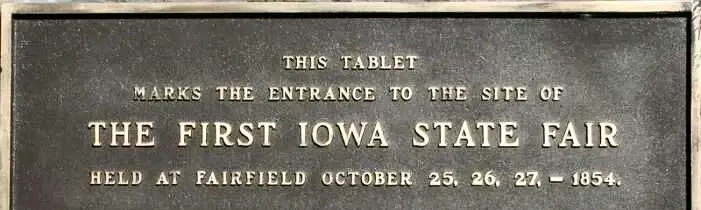 Just sixteen years after Fairfield was named, this town hosted an event that would become one of America's great annual celebrations.
It's October 1854. Iowa has been a state for only eight years. The railroad hasn't reached Fairfield yet. And nearly 10,000 Iowans, arriving on foot, on horseback, in covered wagons, are pouring into a six-acre field on the north end of town. The occasion? The very first Iowa State Fair.
The budget was $323. The admission was 25 cents for adults, free for children. There were 100 horses, 11 pigs, displays of farm implements, and a women's equestrian competition that had the crowd on its feet. A 13-year-old girl from Iowa City, Eliza Jane Hodges, rode so fearlessly that the crowd took up a spontaneous collection of $165 to honor her, because the official prize hadn't gone to her and they weren't having it.
There was no midway, no butter cow, no funnel cake. Just Iowans coming together on the prairie to celebrate what they were building. (There was, however, a giant wheel of cheese, reported to be as big as a wagon wheel and weighed three hundred and sixty pounds.) This state fair tradition, born in Fairfield, now draws more than a million visitors to Des Moines every August. And to mark the fair's centennial in 1954, 509 Fairfielders made the trip to Des Moines in covered wagons, 471 horses in tow. Some things are worth honoring in style.
The Fight for Freedom: Nancy Yancey and the Underground Railroad
Not every chapter of Fairfield's history is celebratory. Some are profound in a different way; quietly heroic, dangerous, and morally essential.
In 1857, a couple named James and Nancy Yancey arrived in Fairfield from Oberlin, Ohio. Both had been born into slavery in what is now West Virginia. Both had found their way to freedom. Nancy had attended Oberlin College, making her one of the most educated women in Iowa at the time. They came to Fairfield not just to start a new life, but with a mission: to establish a station on the Underground Railroad.
James opened a barbershop. Nancy, denied the teaching position her education warranted, opened a laundry where she employed five people. And their home became what Nancy's own obituary would later describe as a place where "many a fugitive from bondage was taken in and cared for... and given a new opportunity to accomplish his freedom."
The risks were real. Slave catchers operated freely. The dangers were constant. And yet the Yanceys stood their ground, year after year, in this southeast Iowa town. They were the first free Black couple to settle in Fairfield, and they chose it as the place to do the most courageous work of their lives.
Nancy Yancey is buried at Evergreen Cemetery in Fairfield, which has been recognized by the National Underground Railroad Network. Her story is honored at the Carnegie Historical Museum.
Mehitable Woods: The Soldiers' Friend
 A few years after the Yanceys arrived, the Civil War came, and Fairfield sent one of the most remarkable people in Iowa history straight into the middle of it.
Mehitable Ellis Woods was not young when the war began. She was not a soldier. She was a Fairfield widow, and she was absolutely immovable. When Iowa troops started coming home wounded from the early battles, Aunty Woods, as the soldiers called her, went to them. First to the hospital in Keokuk. Then, when it became clear the men needed supplies more than they needed sympathy, she started moving toward the front.
For the better part of three years, she loaded wagons, sometimes with 37 tons of food, medicine, clothing, and comfort, and drove them south through Confederate territory to reach Iowa troops. Nine trips. Under fire twice. When a post commander in New Orleans tried to block her final delivery, telling her she couldn't pass even with "a pass for heaven," Aunty Woods showed him her papers from the Secretary of War and walked right past him.
Iowa Governor Kirkwood commissioned her as a Major so she could cut through military red tape more efficiently. The Fairfield fire company was named in her honor. When she died in 1891, the funeral procession stretched from the city park to the cemetery.
Today, her portrait graces the Freedom Rock on the Jefferson County Courthouse lawn. Her story is one that deserves to be shared.
The Inventor Who Changed the World: William Louden
 If there is one Fairfield story that most Americans have never heard, but whose impact most Americans have felt. It is the story of William Louden.
Louden was born near Fairfield in 1841, the son of Irish immigrants. He was small and sickly as a child, which made farm work a struggle. So instead of muscling through, he started thinking. If he couldn't change his body to fit the work, he would change the work to fit the body.
In 1867, he received his first patent for a hay carrier, a device that attached to an overhead rail in a barn and allowed farmers to lift and move hay without breaking their backs. It sounds simple. The impact was enormous. Suddenly barns could be built taller and wider. Farms could store more. Operations that had been limited by human muscle were transformed overnight.
That was just the beginning. Over the next four decades, the Louden Machinery Company, headquartered right here in Fairfield, applied for nearly 200 patents. Flexible barn door hangers. Individual drinking cups for cattle that prevented disease from spreading between animals. Free barn-design services that helped farmers across America build more efficient operations. Louden was, as one editor of Successful Farming magazine put it, someone to whom "agriculture generally is under a debt of gratitude."
But here is where Fairfield's story goes from local pride to national significance. The same overhead monorail system Louden invented to move hay in barns? During World War I, manufacturers realized it could move materials through factories. The technology migrated from the barn to the assembly line, from the hay loft to the automobile plant. William Louden, working from a small Iowa town, had quietly invented a piece of infrastructure that would power American industry for the next century.
When you visit the historic Maasdam Barns just outside Fairfield where champion Belgian and Percheron draft horses were bred from 1910 to 1938, look up. Those original Louden overhead monorail hay carriers are still there. You are looking at the technology that helped build America.
A Library That Started a Movement - And a Museum That Holds the Story
 In 1892, a Fairfield resident named U.S. Senator James Wilson had a building problem. The town needed a permanent home for its library — Iowa's first, established in 1853. He reached out to his friend Andrew Carnegie.
What happened next was a first of a different kind. Carnegie agreed to fund a library in Fairfield, the first time he had ever funded a library in a community where he had no personal ties. The building he funded, completed in 1892, became the model for the 2,800 libraries Carnegie would eventually endow around the world. The Carnegie library movement, which put free books in the hands of millions of Americans and changed the course of public education, started with a conversation about Fairfield, Iowa.
That building still stands at 112 South Court Street. It is now the Carnegie Historical Museum, one of Iowa's five oldest museums, and it holds the layered story of Jefferson County, from Native American artifacts to Underground Railroad exhibits, from William Louden's inventions to a mounted bison head that came from the last Old Settlers celebration held in Fairfield in the early 1900s. A quiet, powerful reminder of everything this prairie was before it became what it is today.
Horses, Wagons, Brushes, and the Spirit of Making Things
 Fairfield has always been a place where people made things - and made them well.
At the Maasdam Barns, J.G. Maasdam imported and bred some of the finest draft horses in the world, including a Belgian stallion named Louis d'Or who was billed as the largest horse on the planet. His Percheron mare Amoretta won the World Championship at the International Livestock Show in Chicago. These weren't hobby horses. They were the engines of American agriculture.
Joel Turney's Charter Oak Wagon Works was turning out 5,000 to 6,000 premium wagons a year by the turn of the century. Dexter Laundry, still employee-owned and operating today, has spent over a century helping laundries around the world run cleaner and more efficiently.
And then there is Harper Brush Works. In 1899, a 21-year-old named Alphonso Harper watched his mother struggle with the family floors and thought: there has to be a better way. He designed a five-piece brush kit from horsehair. It became popular, then beloved, then a nationally recognized brand stocked in Home Depot and Lowe's stores coast to coast. More than a century of American enterprise, started by a young man with an idea and his mother's housework as inspiration. That's Fairfield.
Two Colleges and a Reinvention
 Parsons College, founded here in 1875, grew from a modest Presbyterian school of 500 students into a bustling institution of over 5,500 by the mid-1960s. It was a genuine college town with football games, a packed campus, a feeling of possibility.
When Parsons closed in 1973, the campus went quiet. Then, in 1974, a different kind of institution arrived from California: Maharishi International University, founded by Maharishi Mahesh Yogi and built around a consciousness-based education model that includes the practice of Transcendental Meditation. What followed was one of the most unusual cultural transformations in Iowa history - a conservative Midwestern town, still mourning the loss of Parsons, finding itself home to a global community of meditators, artists, and seekers from around the world.
That transformation is still underway. MIU continues to attract international students to Fairfield, and the town it helped shape — with its organic restaurants, its arts scene, its meditation domes visible from the highway — is unlike anywhere else in Iowa. Or America, for that matter.
Come Find the Story
Two hundred and fifty years into the American experiment, Fairfield, Iowa stands as evidence that the story of this nation didn't just happen in Philadelphia and Boston and Washington. It happened in a log cabin where a woman named Nancy Bonnifield suggested a town's name by a fireplace. It happened in a barbershop and a laundry where a couple risked everything for freedom. It happened in a barn where a sickly kid with a gift for invention changed American agriculture; and then American industry. It happened on six acres of prairie where 10,000 Iowans gathered to celebrate what they were building.
It happened here.

